Skip to content
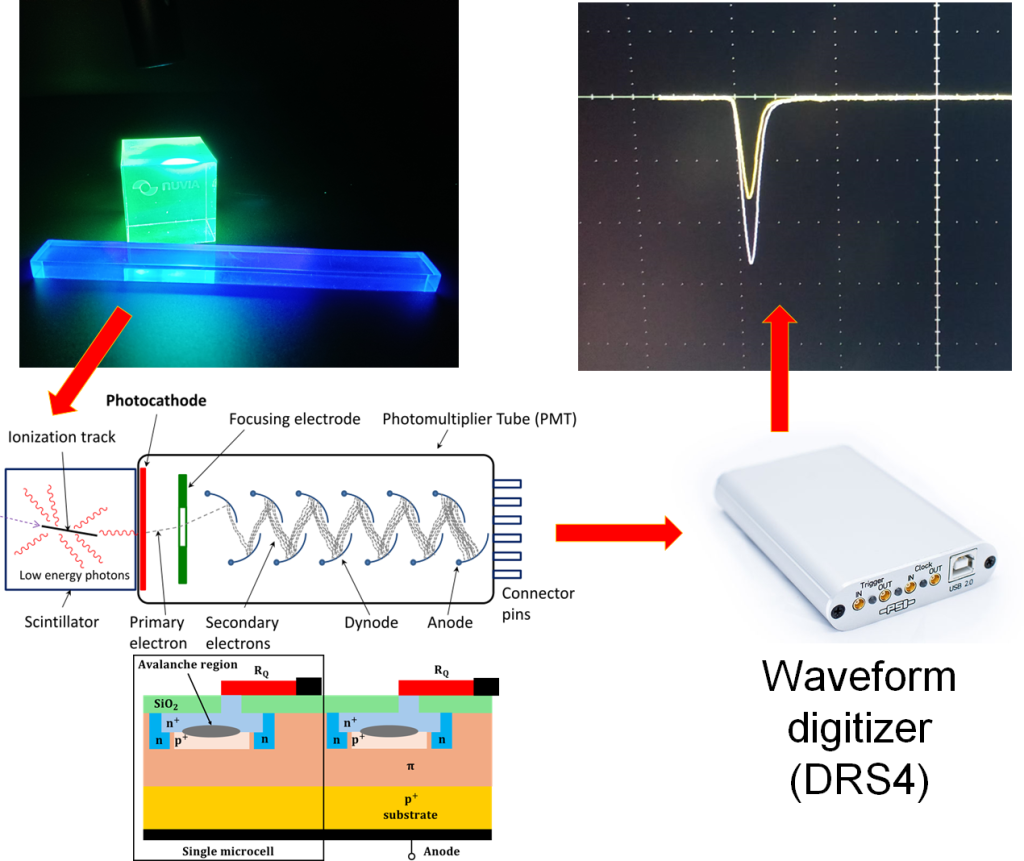
Scintillators (organics and inorganics)
- Made of plastic doped with fluorescent substance or inorganic materials
- Emits light when ionizing particles pass through them[1].
- Light is collected by photodetectors (PMT or SiPM[2]). The resulting electrical signal is usually digitized.
- Fast response (~ns rise time), easy to use.
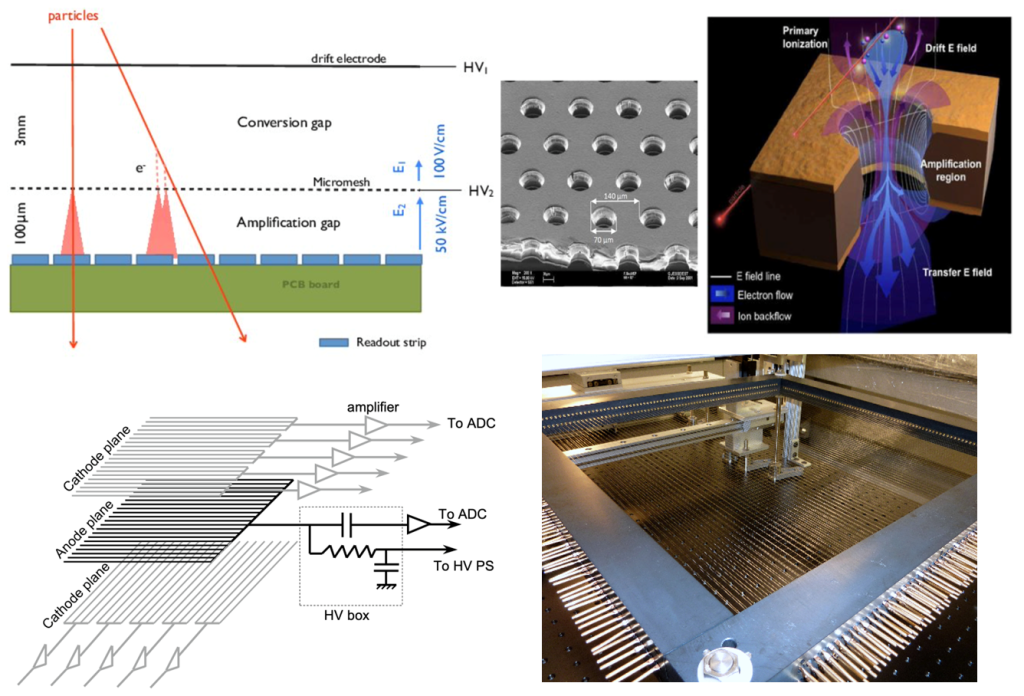
Gaseous Detectors
- A family of detectors that exploits the effect of electron avalanches in a gas-filled chamber upon ionizing particles passages.
- Eg: Geiger tubes, multi-wire proportional chamber[3], time projection chamber.
- Micro-mesh gas detectors (micro-megas)[4], resistive plate chambers (RPC), gas electron multiplier (GEM), etc., offer track reconstruction with sub-mm resolution.
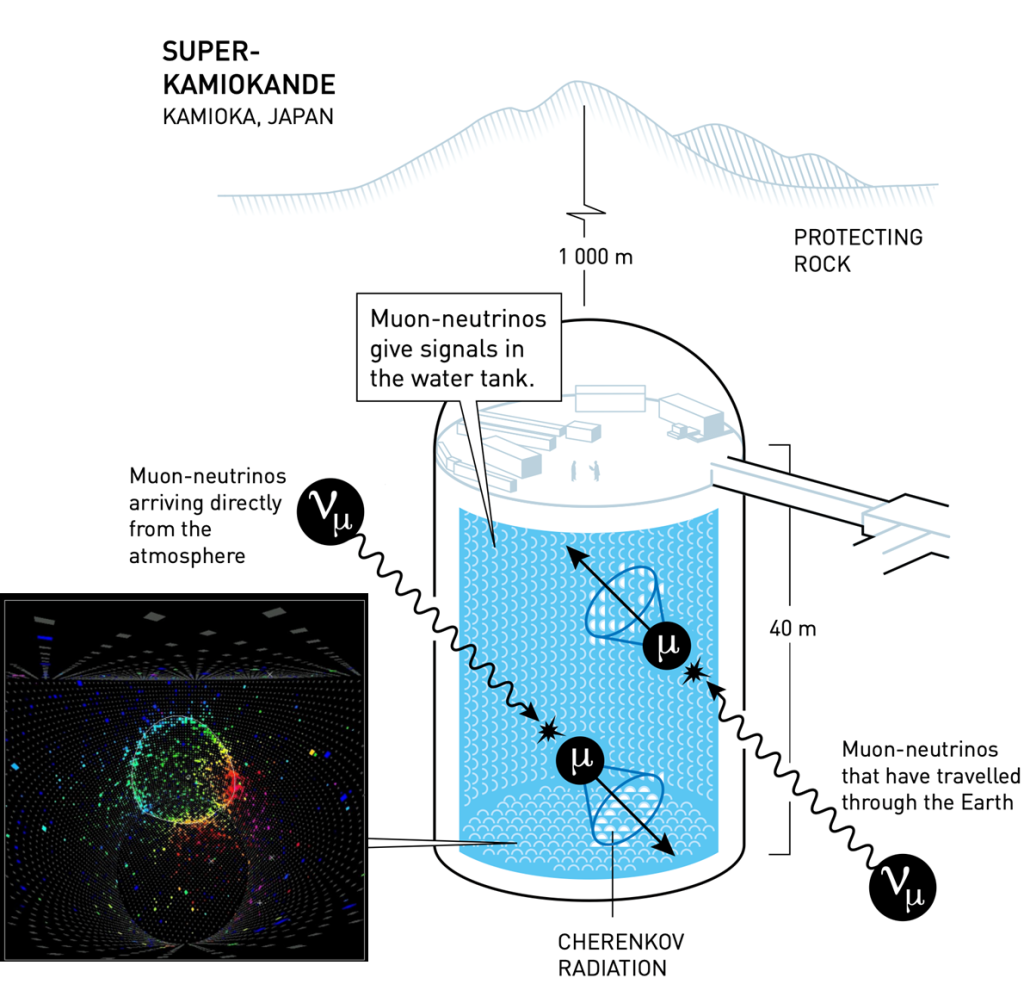
Water Cherenkov Detectors
- Charged particles that move faster than the light in the water generate the Cerenkov radiation, analogous to the sonic boom.
- The event topology of the Cherenkov lights provides information about the direction and type of the particles[5].
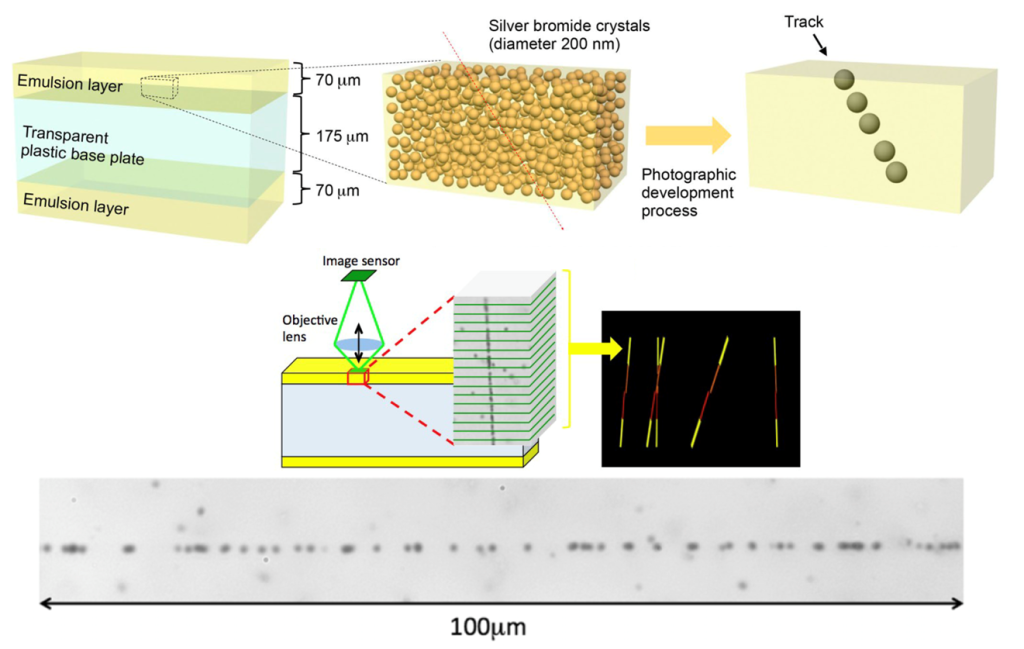
Nuclear Emulsion Technique
- One of the earliest detection technique, captured pion-to-muon decays, providing crucial evidence for the muon’s discovery.
- Automated high-speed nuclear emulsion readout system, combining an optical microscope with the latest computing technologies.
- An alternative in muongraphy applications owing to its sub-µm spatial resolution, lightweight, and portable properties[6].
References
- Masanori, K., Jpn. J. Appl. Phys., 62, 010503 (2023)
- Gundacker, S. & Arjan Heering, A., Phys. Med. Biol., 65, 17TR01 (2020)
- Maxim, T., NIMA, 581, 1-2, 25-37 (2007)
- Fonte, P. & Peskov, V., Plasma Sources Sci. Technol., 19, 034021 (2010)
- Suzuki, Y., Eur. Phys. J. C, 79, 298 (2019)
- Morishima, K., et al., Annals of Geophysics, 60(1), S0112 (2017)